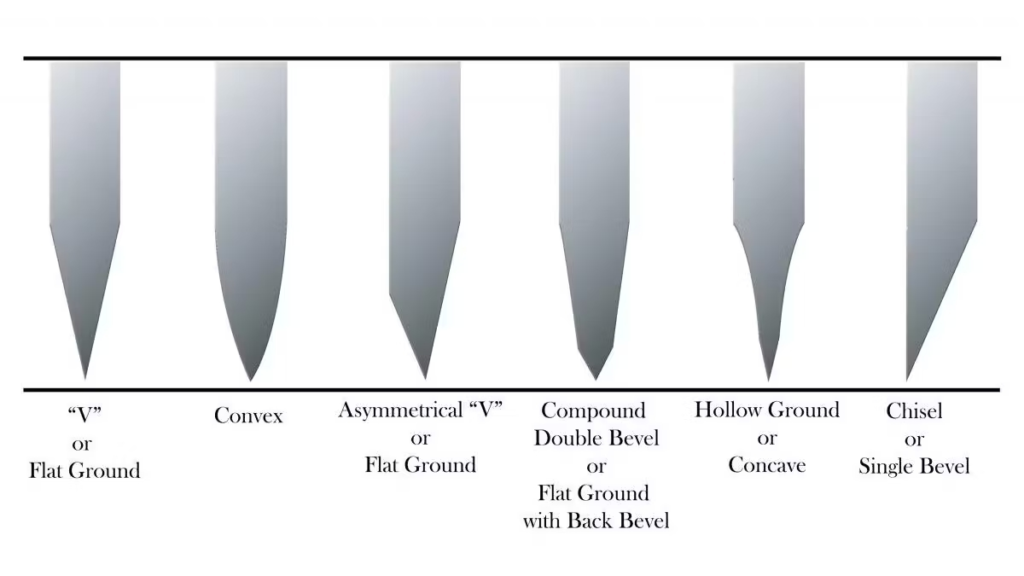
There is a lot to say about Bevels, and there are more bevel shapes than those shown, but these are my favorites and what I will limit this discussion to. From left to right:
“V” or Flat Ground
This is the simplest and easiest to hone. Both sides are flat, symmetrical, and offer a pleasant reflection when polished. The bevel angle can be quite fine, as low as 12 degrees to offer a razor-sharp edge, or a more substantial angle such as 17 to 25 degrees for a stronger edge.
Convex
There are advantages and disadvantages to a convex edge. The geometry does have more metal behind the edge, making it stronger that a flat honed edge, and can offer more weight and balance. Surface contact is reduced, allowing for less friction in sliding cuts and less fatigue during constant use. This edge can be sharpened to as fine as edge as any and will hold its edge a little longer. The disadvantage is that a convex edge is more difficult to sharpen and keep sharp due to the curved surface.
Asymmetrical “V” or Flat Ground
If it wasn’t in the stars, I wouldn’t discuss this bevel. With the exception of a flat secondary grind being opposite a convex bevel, the differences between a symmetrical V grind and an asymmetrical V grind are theoretical with most users expressing no perceived difference.
Compound Double Bevel
This is one of my favorite bevel configurations, for both aesthetic and functional purposes. This is a strong edge for chopping and prying, just the right bevel for that turkey dinner or survival knives. The spine behind the edge is stronger than a long V grind, and will hold up better, without chipping the fine edge. In my humble opinion, for collector’s knives a compound double bevel glitters better than the even reflection of a V grind. Just a matter of taste, I suppose.
Hollow Ground or Concave
Hollow ground knives are extremely sharp, out of the box. The edge and blade are thin, making this grind more susceptible to bending and twisting when chopping and prying. The small edge bevel requires frequent and skillful sharpening. This is a specialized edge used on straight razors, skinners, and light duty folding knives, and is not considered practical for general purpose blades.
Chisel or Single Bevel
Typically, the sharpest edge possible since only one side of the bevel is sharpened. This is a handed knife, meaning it is sharpened to be used by either a right or left-handed person. The blade does pull toward the flat side which is useful for some cutting purposes like Sashimi and hard vegetables. Often the side opposite the flat side is hollow ground for fine cuts.